Gokul's most beloved thief
Gokul was a village of cowherds. Every home had cows, curd set in every courtyard, and each morning the lanes woke to the sound of churning. In the house of Nanda and Yashoda lived a little boy whose mischief was the talk of the village.
In the Bhagavata Purana (10.8), the gopis come to Yashoda half laughing and half annoyed. Your little one unties the calves before milking time, they say. If we scold him, he laughs. He invents new ways to steal, and he shares the butter he takes with his friends and the monkeys. If the monkeys won't eat, he breaks the pot.
We hang the pots high from the ceiling, they continue, but he piles up stools and mortars and climbs, or makes a hole from below and lets the curd run out. Even in a dark room the glow of his body lights his way. And when we catch him, he puts on such an innocent face that our anger melts.
Complaints that turned into love
The loveliest part of these complaints is that, even as they speak, the gopis cannot stop gazing at Krishna. The Bhagavata says Yashoda would look at her son's frightened little face, burst out laughing and lose all wish to scold him. The women who had come to complain often left laughing too.
The devotional tradition sees this not as theft but as a play of love. Vaishnava commentators say the gopis secretly wanted Krishna to come to their homes, so his stealing was a blessing, not an insult. Centuries later, bhakti poets such as Surdas wrote many songs on these scenes, in which Krishna protests, Mother, I didn't eat the butter. Those songs came long after the Bhagavata, but they carried this leela into every home.
The churn, the broken pot and a runaway child
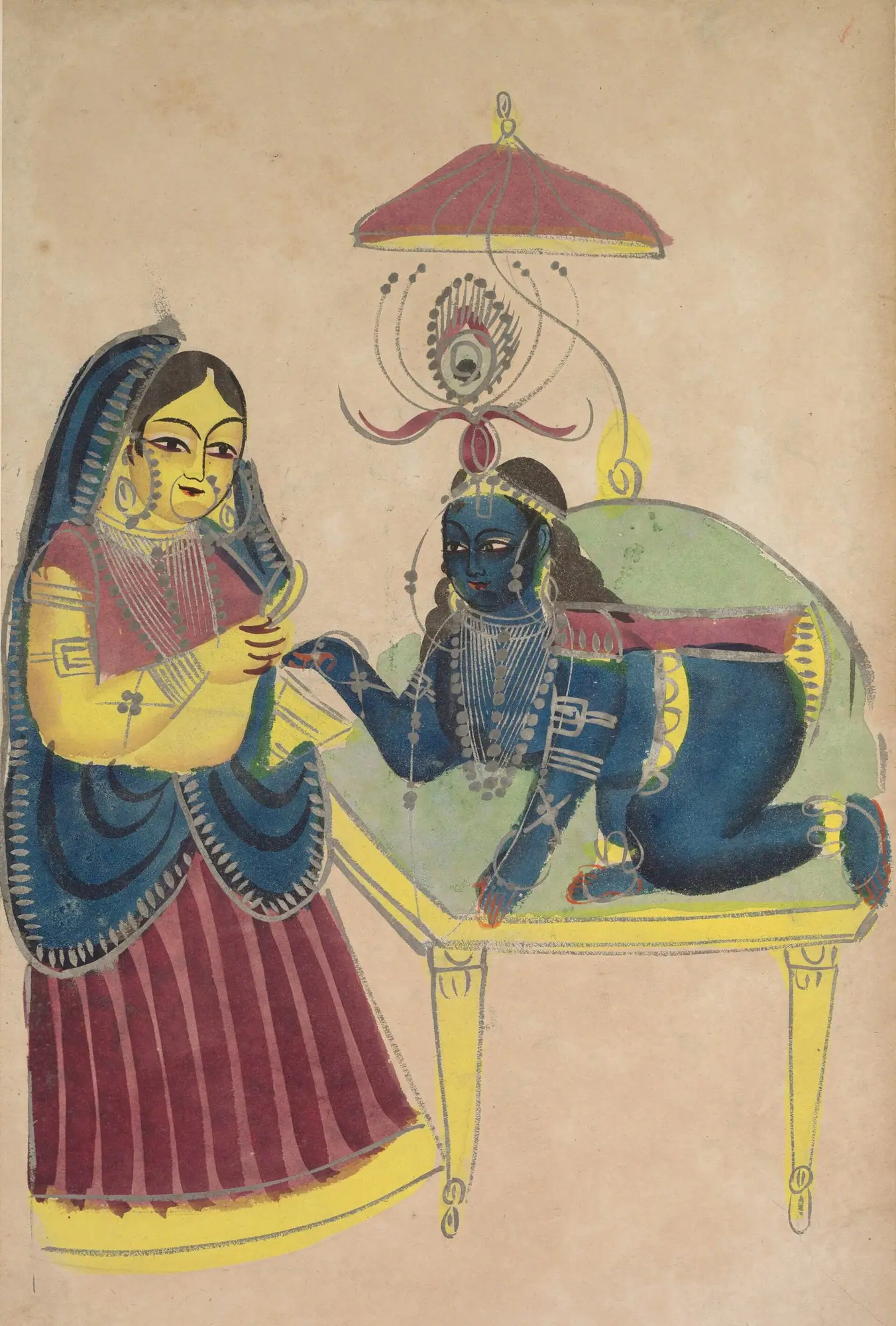
The ninth chapter of the Bhagavata opens one morning with Yashoda churning curd herself, singing songs about her son's adventures. Hungry, Krishna came and caught hold of the churning rod, insisting on being fed. Yashoda took him in her lap and was nursing him when the milk on the stove began to boil over. She set him down and hurried to save it.
Left half-fed, the child was hurt. In a temper he broke the pot of curd with a stone, went inside, took the butter and climbed onto an upturned mortar to feed the monkeys. When Yashoda came back and saw the broken pot, she knew exactly who had done it.
She ran after him with a stick, and Krishna fled, pretending to be terrified. Here the Bhagavata makes a striking remark: the one whom yogis cannot catch even in meditation was being chased by a mother. At last, exhausted, Yashoda caught him and, seeing him cry, threw the stick away.
A rope two fingers short
Yashoda decided to tie him up for a while so he would cause no more trouble. She brought a rope and began to tie his waist to the mortar, but the rope was two fingers too short. She joined another rope; still two fingers short. She joined every rope in the house, and the gap remained.
The gopis gathered and laughed, and Yashoda smiled in wonder too, but she did not give up. When Krishna saw his mother drenched in sweat and worn out, he let himself be tied. The Bhagavata says the Lord cannot be bound by force; he is bound only by love.
Because a rope was tied around his waist, Krishna got the name Damodara, the one with a cord around his belly. In the month of Kartik, many families still worship Damodara and light lamps in his honour.
Two trees and an old curse
Yashoda went back to her work. In the courtyard stood two great Arjuna trees side by side. The Bhagavata (10.10) explains that they were Nalakuvara and Manigriva, sons of Kubera, whom the sage Narada had cursed to become trees because of their arrogance and carelessness, with the blessing that Krishna's touch would one day free them.
Still tied, little Krishna crawled between the two trees, dragging the mortar behind him. It caught crosswise; he pulled, and both trees crashed down, roots and all. From them emerged two radiant beings, who praised Krishna and returned to their world.
Hearing the crash, Nanda and the cowherds came running. They found the trees on the ground and, between them, a smiling child tied to a mortar. Some of the children said Krishna had done it, but the adults could not believe them. Nanda quietly untied his son. A morning that began with mischief ended with two souls set free.