A new journey after the sacrifice
The sacrifice at Siddhashrama was finally complete. Two princes of Ayodhya, Rama and Lakshmana, had guarded it against Tataka, Subahu and Maricha. Only weeks earlier they had been boys in a palace; now they had lived through forest nights, long vigils and the real test of archery.
When the rites were over, the sages mentioned that King Janaka of Mithila was holding a great sacrifice, and that a remarkable bow was kept in his court. Vishvamitra asked the brothers to come along, and they agreed as readily as they had agreed to follow him into the forest. On the way they crossed the Ganga, passed the city of Vishala and reached the hermitage of the sage Gautama, where the episode of Ahalya's release took place. At every stop Vishvamitra told a story or explained a place, as if the road itself were a classroom.
Janaka's court and the bow of Devarata
In Mithila, King Janaka welcomed the sage with great respect, though his eyes kept returning to the two young men beside him. Vishvamitra introduced them as the sons of King Dasharatha and said they wished to see the bow everyone talked about.
Janaka then told its history. According to Valmiki, the bow had belonged to Lord Shiva, and the gods had entrusted it to Janaka's ancestor Devarata. For generations it had stayed in the royal house of Mithila. Many mighty kings had come to try it, but none could lift it, let alone bend it.
Janaka also spoke of his daughter. Once, while a field was being ploughed to prepare ground for a sacrifice, a baby girl had appeared from the earth, and she was named Sita. Janaka had vowed that she would be viryashulka: her hand would go only to someone who met this test of strength. Some kings had left humiliated, and a few had even made war, but the bow had not moved.
The eight-wheeled chest and a calm young man
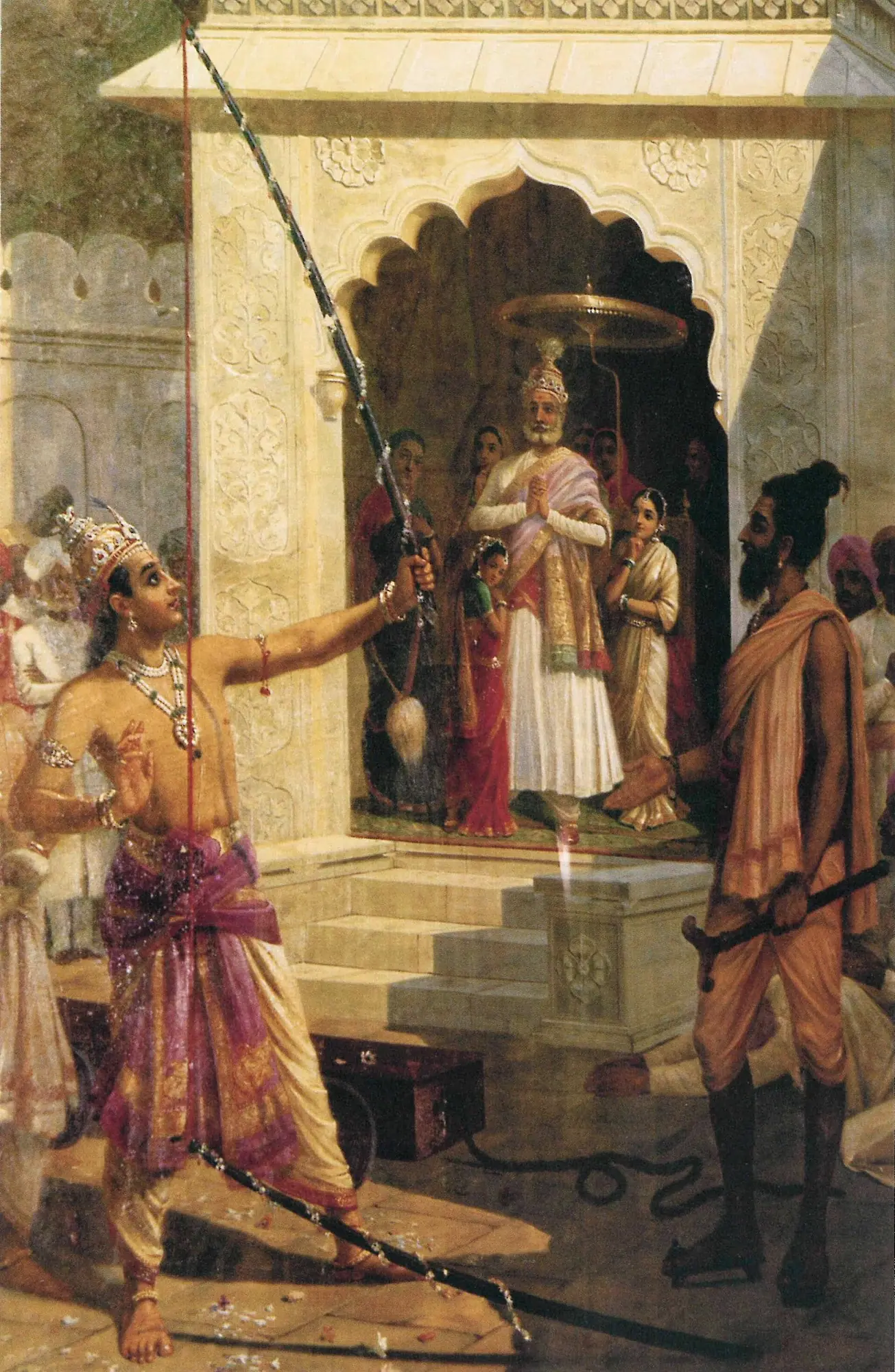
At Vishvamitra's request, Janaka had the bow brought in. Valmiki says it lay in a huge iron chest on an eight-wheeled cart, hauled by five thousand strong men. The hall fell silent. If so many people could barely move it, how could one young man lift it?
Rama first looked at his teacher. Vishvamitra said only, look at the bow, my child. Rama stepped forward, opened the chest and lifted the bow as if it were an ordinary object. Before the court could draw breath he had strung it. Then, as he drew the string back to his ear, the bow snapped in the middle.
Valmiki describes the sound as a thunderbolt. The ground shook, and most of the assembly fainted, except Janaka, Vishvamitra and the two brothers. When everyone recovered, Janaka had tears in his eyes. Years of waiting were over.
The vow fulfilled and word sent to Ayodhya
Janaka declared that his vow was fulfilled and that Sita would marry Rama. Yet he did not decide alone. With Vishvamitra's consent, swift messengers rode to Ayodhya so that King Dasharatha could come and give his blessing in person. It is a small detail, but it shows that in the Ramayana a marriage joins two families; it is not simply a prize for strength.
Dasharatha arrived with his teacher Vasishtha and the whole family. Four weddings took place: Rama married Sita, Lakshmana married her sister Urmila, and Bharata and Shatrughna married Mandavi and Shrutakirti, daughters of Janaka's brother Kushadhvaja. The bond between Mithila and Ayodhya became the foundation of everything that follows in the epic.
Two traditions, two pictures
Most of us know this scene from Tulsidas's Ramcharitmanas or from Ramlila performances. There it is a grand swayamvar: kings from many lands fail to lift the bow, Janaka despairs that the earth has run out of heroes, and Lakshmana bristles with anger. The moment the bow breaks, Parashurama storms into the hall, leading to his famous exchange with Lakshmana.
Valmiki's account is quieter. The bow is brought out at Vishvamitra's request, and Rama meets Parashurama only later, on the road back to Ayodhya, where Parashurama challenges him to string the bow of Vishnu. Both versions are read with devotion. Knowing the difference does not diminish the story; it shows how one narrative travelled through centuries and settled into people's hearts in more than one form.