Defeat on the first day
The war had begun and many of Lanka's great warriors had fallen. At last Ravana himself took the field. In Valmiki's Yuddha Kanda, the first encounter between Rama and Ravana is thrilling. Rama destroyed Ravana's chariot, charioteer and bow, leaving him standing unarmed.
Rama could have ended Ravana's life at that moment, but he did not. You are tired and you have no weapons, he said. Go, rest, and come back tomorrow with a new chariot and new weapons; then you will see my strength. Not striking an unarmed enemy was a rule of righteous war, and Rama kept it.
Humiliated, Ravana returned to Lanka. For the first time he feared defeat. Then he remembered the brother who lay in deep sleep even in the middle of the war.
A boon from a slip of the tongue
The Uttara Kanda explains this sleep. Ravana, Kumbhakarna and Vibhishana had all performed severe austerities to Brahma. Kumbhakarna's body was so enormous and his hunger so terrible that the gods feared that, given the boon he wanted, he would devour creation.
At the gods' request, the goddess Saraswati entered Kumbhakarna's speech as he asked for his boon. A well-known tradition says he meant to ask for the seat of Indra, but out came the seat of sleep instead. According to Valmiki, he asked to sleep for many years. Later, at Ravana's request, Brahma softened it, and in popular tradition Kumbhakarna slept for six months and woke for a day.
The story shows that power without judgement can lose even the greatest opportunity to a few wrong words.
An enormous awakening
Ravana ordered that Kumbhakarna be woken by any means. Valmiki writes the scene with great humour. The demons piled mountains of food before him, beat drums, blew conches, struck him with clubs and drove elephants over him. Yet his breath alone kept blowing them off their feet.
After enormous effort he woke, stretched and began to eat the food laid before him. Then he was told that Rama's army had surrounded Lanka and the king was in danger.
Kumbhakarna went to Ravana. What happened there is the most interesting side of this character.
Honest counsel, and loyalty anyway
In the Yuddha Kanda, Kumbhakarna rebukes Ravana bluntly. A king who ignores the advice of ministers who wish him well and acts in haste invites destruction, he says. That is what you did by abducting Sita. Vibhishana was right.
Stung, Ravana replied that he had woken him to fight, not to lecture. Then Kumbhakarna said: let what is done be done. You are my brother and my king, and I will fight for you. He recognised the wrong, but he would not abandon his brother.
Tulsidas's Ramcharitmanas adds another moving scene. Before the battle, Vibhishana comes to meet Kumbhakarna. Kumbhakarna embraces him and says: you did right to choose the path of dharma. Go now; my fate is taking me into battle.
Hanuman, Sugriva and Kumbhakarna
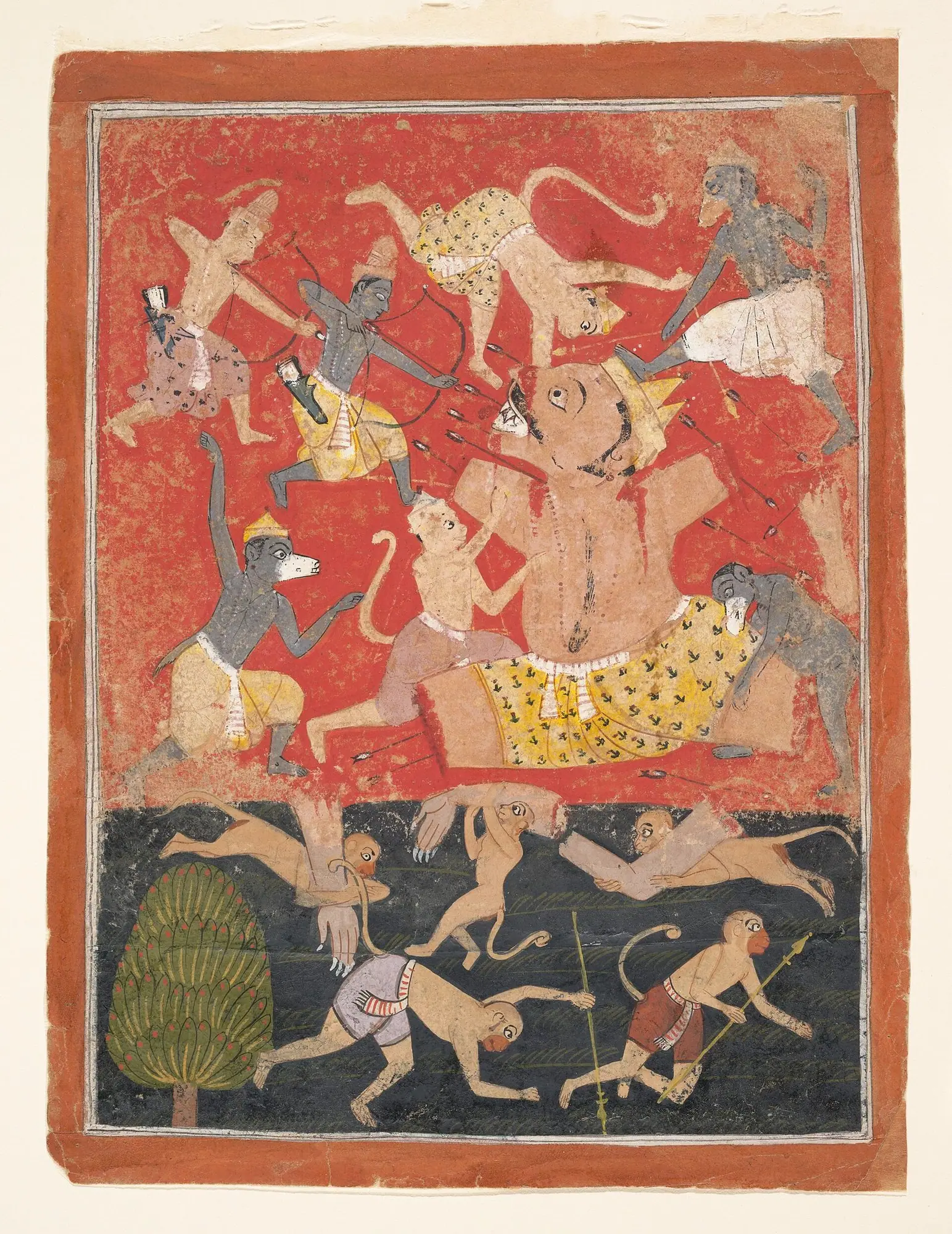
When Kumbhakarna strode onto the battlefield, the monkey army scattered in panic. He swallowed every monkey within reach. Hanuman tore off a mountain peak and struck him with it, wounding him, but Kumbhakarna wounded Hanuman with his spear in return.
Then he seized Sugriva, king of the monkeys, and carried him off towards Lanka as a prisoner. Sugriva lay stunned for a while, but as soon as he came to, he tore off Kumbhakarna's ears and nose with his teeth and nails, and leapt free. Humiliated and enraged, Kumbhakarna returned to the battlefield.
Now Rama himself faced him. Rama's arrows cut off first his arms, then his legs, and finally a swift arrow severed his head. Valmiki says that as his giant body fell, Lanka's gates and ramparts were shattered.
How to remember Kumbhakarna
In everyday speech, Kumbhakarna has become a byword for laziness and oversleeping, but the Kumbhakarna of the Ramayana is far more complex. He is both a truthful adviser and a brother loyal to the very end. His tragedy is that he saw right and wrong clearly and still stood on the side of wrong.
Vibhishana and Kumbhakarna, two brothers, knew the same truth but chose different paths. The Ramayana invites us to understand both.
Some regional retellings and folk performances treat Kumbhakarna with special sympathy, presenting him as an honest giant trapped by a boon he never meant to ask for and by loyalty to a brother he could not save. Seen this way, his story is less about sleep and more about the cost of staying silent too long.