A journey for a flower
The Treta age had passed, and in the Dvapara age the Pandavas were visiting the pilgrimage sites of the Himalayas during their twelve years of exile in the forest. The Vana Parva of the Mahabharata tells how one day a divine flower, carried on the wind, fell beside Draupadi. It had a thousand petals and a wonderful fragrance. It was the Saugandhika flower.
Draupadi told Bhima that she wanted more such flowers. To fulfil his wife's wish, Bhima at once took up his mace and set off in the direction the wind was blowing from. He headed for Mount Gandhamadana, breaking trees, scattering animals and roaring loudly as he went.
Bhima was a son of the wind, born from a portion of the wind god, Vayu. Hanuman too was a son of the wind. That made Hanuman Bhima's elder brother, but Bhima had forgotten this, or perhaps had never really thought about it.
A monkey lying on the path
On a mountain path, in the middle of a grove of banana trees, Bhima saw an old monkey lying down. Its body glowed, but it looked very tired and weak. Its long tail stretched right across the path, leaving no way through.
Bhima roared: move, I need to go on. The monkey slowly opened its eyes and said: I am sick and old, and I cannot get up. You seem wise, so why are you making such a noise? And the path ahead is not for humans; it belongs to the gods.
Bhima's anger grew. I am of the Kuru line, he said, the son of Kunti and of the wind god, and my name is Bhima. Let me pass, or I will leap right over you. The monkey replied: I am very old, and leaping over me would not be proper. If you must go on, just lift my tail, set it to one side and pass.
The tail that would not move
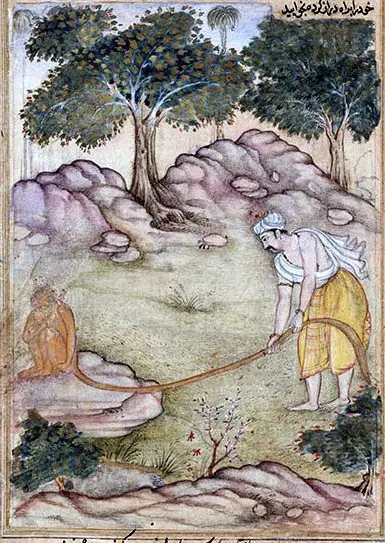
Bhima laughed. He had lifted and thrown elephants; what was an old monkey's tail to him? He casually grasped the tail with his left hand and tried to lift it. It did not even stir.
Then he gripped it with both hands and put all his strength into it. His brows knotted, his eyes bulged and his body was drenched in sweat. The Mahabharata says Bhima could not raise the tail even slightly. In the end he stood ashamed, with his head bowed.
At that moment all of Bhima's pride shattered. He folded his hands and asked: who are you? Are you a perfected sage, a god or a gandharva? Please forgive me and tell me who you are.
A brother revealed
The monkey smiled and said: I am Hanuman, son of Kesari, king of the monkeys, and son of the wind god. That makes me your elder brother. Then he told the story of Rama in brief: how he had served Rama, leapt the ocean and found Sita. He explained that Rama had granted him the boon of living as long as Rama's story endured.
He told Bhima that he had blocked the path because the region ahead belonged to the gods, and Bhima might have met with a curse or harm there. Stopping him was a brother's protection, not an insult.
Bhima was filled with joy. He bowed to Hanuman and made one request: I have heard that you took on a vast form when you leapt the ocean. Please show me that form.
The wisdom of the ages and the vast form
Hanuman first explained to Bhima that every age has its own nature. He described the four ages: in the Satya age dharma is complete; in the Treta it diminishes a little; in the Dvapara only half remains; and in the Kali age it becomes very weak. That form belonged to that age, he said; times have changed.
When Bhima kept insisting, Hanuman began to grow. He became as tall as a mountain and shone like the sun, and all of Gandhamadana lay in his shadow. Bhima closed his eyes, for that radiance was hard to look upon. Then Hanuman returned to his ordinary form.
Hanuman also taught Bhima about the duties of a king: a ruler must protect his people, keep wise counsellors and walk the path of dharma. For Bhima, it was an elder brother's blessing.
A promise to roar from the banner
As they parted, Hanuman embraced Bhima. The Mahabharata says that embrace took away all of Bhima's weariness and gave him fresh strength. Ask for a boon, Hanuman said.
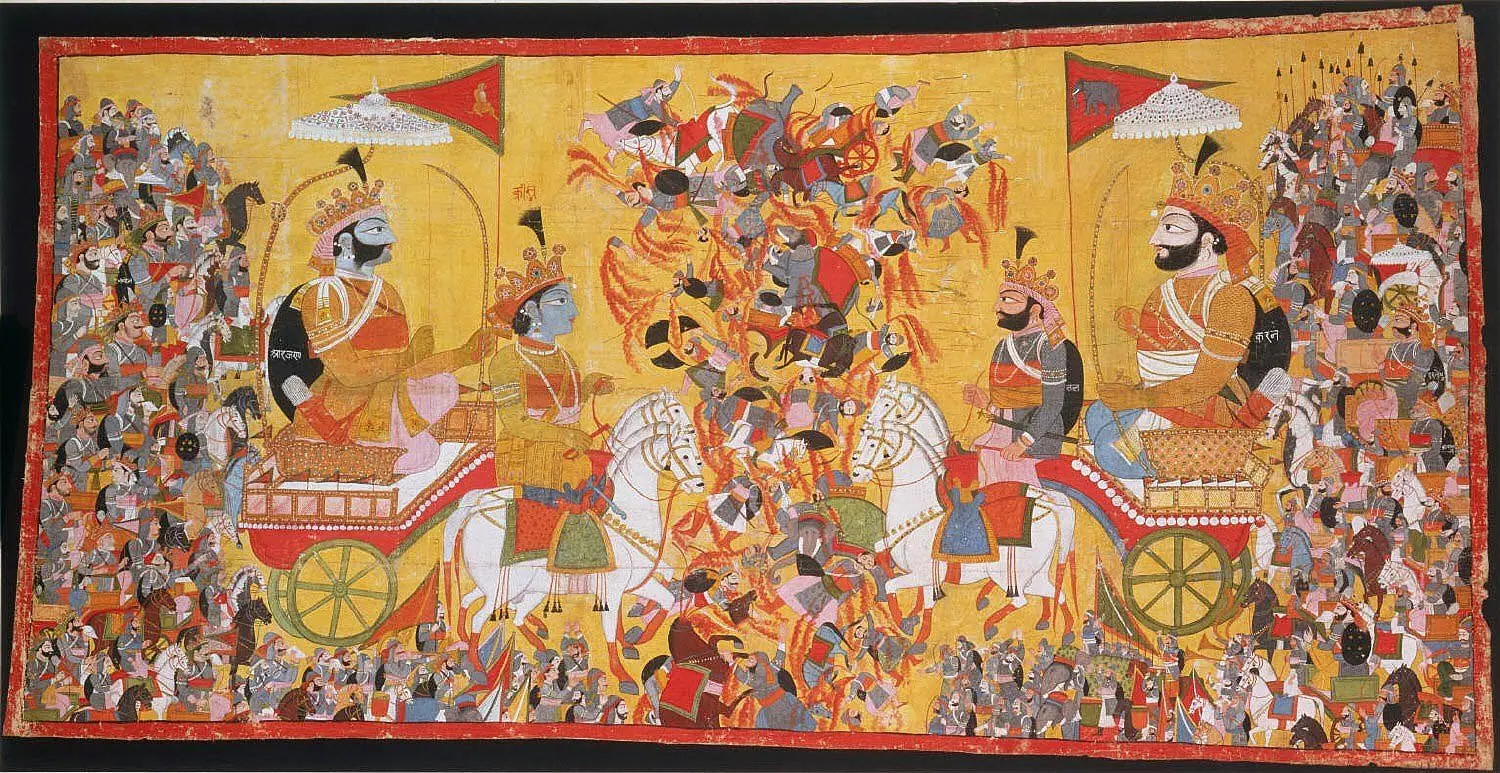
Then Hanuman made a promise of his own: when you roar like a lion among your enemies on the battlefield, I will make your roar mightier with mine. Seated on the banner of Arjuna's chariot, I will let out such a terrible cry that your enemies will tremble. Then he showed Bhima the way to the lake of Saugandhika flowers and vanished.
In the next story this very banner, the Kapidhvaja or monkey banner, appears in the Mahabharata war, and a folk tale tells how Hanuman came to be on Arjuna's flag.