Arjuna on the shore at Rameswaram
In the Mahabharata, Arjuna travelled on pilgrimage to many sacred sites in South India. A folk tale connected with that journey is very popular in the South. It is not found in the original text of the Mahabharata but comes from storytellers and temple traditions.
According to the tale, Arjuna reached Rameswaram and looked out across the sea, where Rama's bridge had once been built. A thought came to him and he said aloud: Rama was such a great archer, so why did he make the monkeys toil so hard to build a bridge of stones? He could simply have built one with arrows.
Arjuna was proud of his archery, and rightly so. He had pierced the eye of the fish at Draupadi's bridegroom contest and received divine weapons from the gods. But hidden in that pride was a small seed of arrogance.
A small monkey's challenge
Nearby sat a small, ordinary-looking monkey. It heard Arjuna and said with a smile: how could a bridge of arrows bear the weight of a monkey army? It would break the moment a single monkey climbed onto it.
Arjuna was stung. I will build a bridge of arrows right now, he said; walk on it and see. The monkey asked what would happen if the bridge broke. In the heat of the moment Arjuna declared: if my bridge cannot bear your weight, I will enter a fire and give up my life.
Arjuna raised his bow, the Gandiva, and in no time built a strong bridge of arrows across the sea. Now walk on it, he said proudly.
A broken bridge and Arjuna's vow
The monkey placed its first step on the bridge. At that moment it increased its weight, and the whole bridge creaked and scattered into the sea. Arjuna was speechless. Now he had to keep his vow.
He gathered wood on the shore and lit a fire. He was about to step into it when a young brahmin boy arrived. What is happening? he asked. Hearing everything, he said: a wager should never be judged without a witness. I will be your witness; build the bridge again and let the test be repeated.
Arjuna built the bridge of arrows again. Again the monkey climbed onto it and increased its weight, this time even more, but the bridge did not budge.
Who was beneath the bridge?
Astonished, the monkey stepped down. Peering into the water, it saw a giant tortoise beneath the bridge, holding it up on its back, and blood flowing from that back. In some tellings it is a tortoise, in others the brahmin boy himself. When they all looked closely, Krishna stood where the boy had been.
At that moment the monkey too showed its true form. It was Hanuman. The two recognised each other: one the servant of Rama in the Treta age, the other Krishna, who had come in the Dvapara age as another form of the same Lord. Hanuman bowed to Krishna, and Arjuna asked them both for forgiveness.
Krishna explained to Arjuna that his bridge had held not because of his skill but by divine grace. And he told Hanuman that by breaking a devotee's pride, he had protected him.
A promise to sit on the banner
The folk tale says that Hanuman then promised Arjuna that in the coming great war he would sit on the banner of his chariot and protect it. This promise matches the Mahabharata episode in which Hanuman makes a similar promise to Bhima on Mount Gandhamadana.
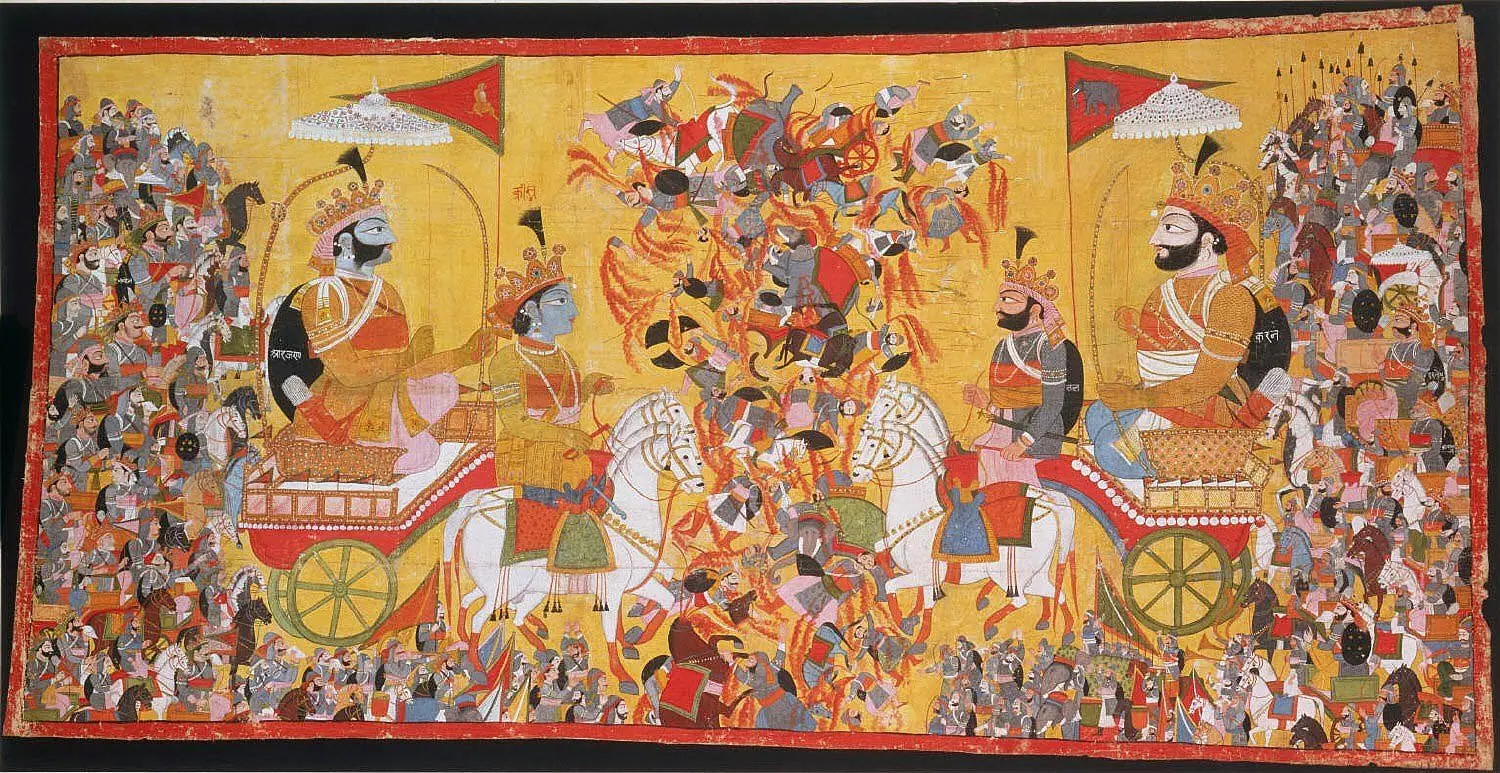
The Mahabharata mentions the monkey banner on Arjuna's chariot again and again. In the twentieth verse of the very first chapter of the Bhagavad Gita, Arjuna is called Kapidhvaja, the one whose banner bears a monkey. In battle, enemies could recognise this flag from far away.
The burning chariot at the war's end
The Shalya Parva of the Mahabharata contains a remarkable scene. When the eighteen-day war ended, Krishna told Arjuna: you get down from the chariot first, and then I will. As soon as Arjuna stepped down, the divine monkey on the banner vanished. Then Krishna got down, and at that very moment the whole chariot burst into flames and was reduced to ashes.
When the astonished Arjuna asked why, Krishna explained that the chariot had long since been burned by the enemy's divine weapons. It had survived only because he was seated on it. Tradition also holds that Hanuman, seated on the banner, protected the chariot throughout the war.
In this way the folk tale's promise and the Mahabharata's scene become one. The next story is another folk tale, in which the pride of Garuda, Satyabhama and the Sudarshana discus is broken in Dwarka.