A frightened king on a mountain
On Mount Rishyamukha, near Kishkindha, the monkey king Sugriva lived in hiding with four ministers. His elder brother Vali had driven him from the kingdom, taken his wife and was hunting him. Sugriva survived only because an old curse prevented Vali from setting foot on Rishyamukha.
Fear had become Sugriva's constant companion. Every sound seemed to be one of Vali's spies. One day he saw two young men approaching Lake Pampa. They carried bows and swords, walked with the confidence of kings, and their faces were full of grief.
Sugriva trembled and fled with his ministers from one peak to another. Then his wisest minister, Hanuman, calmed him down. A king should not panic like this, he said; first let us find out who they are.
The disguise of a mendicant
Sugriva gave the task to Hanuman. Go in an ordinary guise, he said, read their words and manner, and if they have been sent by Vali, signal to me. According to the Valmiki Ramayana, Hanuman set aside his monkey form and took the form of a mendicant. In Tulsidas's Ramcharitmanas he goes disguised as a brahmin.
The choice shows Hanuman's judgement. A monkey warrior suddenly appearing before two archers might have provoked a fight. Nobody raises a weapon against a quiet mendicant, and people speak openly to one. The first rule of diplomacy: trust first, then introductions.
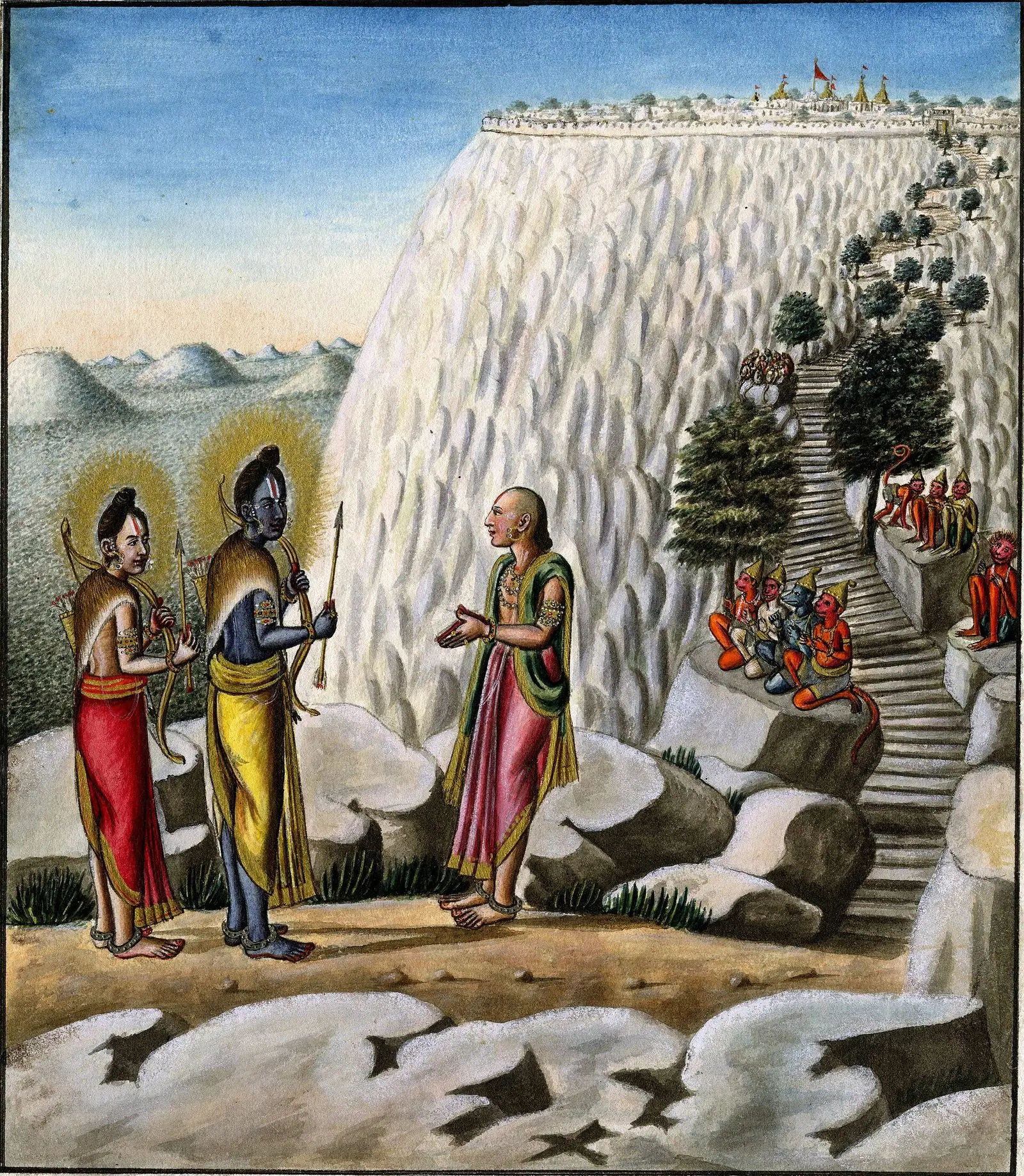
Hanuman came down the mountain, bowed respectfully to Rama and Lakshmana and began to speak.
Speech without a single flaw
Hanuman first praised the brothers' radiance and bearing. He asked why men as splendid as royal sages were wandering in this harsh forest, why they carried such divine bows, and who they were. Then, without any pretence, he introduced himself: I am Hanuman, minister of Sugriva, king of the monkeys, who wishes to be your friend.
Rama listened quietly and then turned to Lakshmana. Valmiki records his words at length. No one who has not studied the Rig, Yajur and Sama Vedas could speak like this, Rama said. He must have studied grammar thoroughly many times, for in all he has said not one word was wrong.
Rama added that while he spoke his brows did not knit, his forehead did not furrow and his eyes showed nothing unnatural. His speech was neither too long nor too short, neither too soft nor too loud. Such words could win over even an enemy with a raised sword. A king who has such a messenger will succeed in all he undertakes.
The moment of recognition
Lakshmana told Hanuman that this was Rama, son of King Dasharatha of Ayodhya, who had come to the forest at his father's command, and that a demon had carried off his wife, Sita. They themselves were seeking Sugriva's help.
Tulsidas fills this moment with devotion. In the Ramcharitmanas, as soon as Hanuman realises he is standing before his Lord, he forgets his disguise and falls at Rama's feet. Tears stream from his eyes as he says: Lord, I was slow to recognise you.
Rama raises him and embraces him. The Manas records Rama's famous words that Hanuman is twice as dear to him as Lakshmana. With that, the relationship moved beyond master and servant to deep affection at the very first meeting.
Rama and Lakshmana on his shoulders
According to Valmiki, Hanuman resumed his true monkey form and carried both brothers on his back up the mountain to Sugriva. The small scene foreshadows the whole epic: the Hanuman who lifted Rama that day would carry the weight of every hard task in Rama's mission.
When they reached Sugriva, Hanuman lit a fire. Rama and Sugriva walked around it and pledged friendship. Sugriva promised his full help in the search for Sita, and Rama promised to protect him from Vali's injustice.
At the same meeting Sugriva showed them ornaments that a woman had dropped from the sky as a demon carried her away. Lakshmana recognised Sita's anklets. The search finally had a direction.
What this meeting teaches
In this episode Hanuman appears in three roles: a careful minister protecting his king, a skilled envoy who reaches the truth without confrontation, and a devotee who gives himself completely once he recognises the right person.
Rama's response is just as instructive. He recognised Hanuman not by his species or appearance but by his speech, humility and intelligence. In the rest of the story, this monkey became his greatest helper.